
U.S. equities continued to advance during the week ending July 10, led by renewed strength in technology and AI-related stocks. The S&P 500 gained 1.2%, and the Nasdaq rose 1.7%, while the Dow slipped 0.5% after recently reaching record highs. Investors were encouraged by resilient economic data, including another week of low jobless claims, reinforcing confidence that the U.S. economy remains on a solid footing. The 10-year Treasury yield moved modestly higher to approximately 4.56% as markets continued to evaluate the outlook for inflation and Federal Reserve policy, with a focus on potential rate hikes rather than cuts. Although geopolitical tensions in the Middle East resurfaced, markets remained remarkably durable as investors increasingly focused on strong corporate fundamentals and the upcoming earnings season. Year-to-date, all three major indexes remain solidly positive, reinforcing our long-standing mantra: stay the course, ignore the noise, and remain focused on long-term results.

U.S. & Global Economy
- Despite ongoing concerns that artificial intelligence could displace jobs, the labor market remains remarkably healthy, with businesses continuing to hire and wages supporting consumer purchasing power. A healthy and nearly fully employed labor market is the foundation of a healthy economy because employed consumers are more likely to spend, which fuels roughly two-thirds of U.S. economic activity. As long as businesses continue to invest, hire, and improve productivity through technologies such as AI, the outlook for consumer spending, corporate earnings, and long-term economic growth remains favorable.
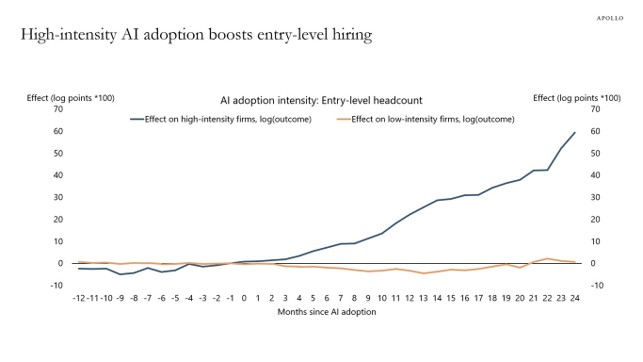
A new Ramp study, which matched AI spending with workforce records across 21,559 U.S. firms, found that companies adopting AI grew their headcount by 10% within two years. Further, and somewhat paradoxically, these gains are driven entirely by high-intensity AI adopters, with entry-level employment increasing by approximately 12%, suggesting that significant AI investment is complementing workforce growth rather than replacing workers (see the Apollo chart below). This is another encouraging sign for the broader U.S. economy.
Policy and Politics
- Geopolitical risks remain largely manageable and regionally contained, although uncertainty persists. While negotiations between the U.S. and Iran continue and isolated regional tensions remain, energy markets have largely stabilized, with Brent crude holding near the low-$70s per barrel. Lower oil prices have eased concerns about renewed inflationary pressures and reduced one of the key risks facing the global economy. Importantly, despite several ongoing regional conflicts, much of the world continues to operate in a relatively stable economic and political environment, allowing businesses to invest, consumers to spend, and global trade to continue expanding. While geopolitical developments warrant continued monitoring, we believe the improving energy backdrop and the resilience of the global economy provide a constructive foundation for investors as the second half of 2026 unfolds.
As we move further into the second half of 2026, the investment landscape remains constructive despite periodic volatility. Recent economic data continue to point to a resilient U.S. economy, while inflation appears to be gradually moderating even as the Federal Reserve maintains a cautious stance. Investor attention is now turning to the second-quarter earnings season, where companies will need to demonstrate that continued investments in artificial intelligence and productivity initiatives are translating into stronger financial results. We continue to believe the U.S. economy is well-positioned to navigate today’s challenges, supported by healthy consumer spending, a solid labor market, and ongoing innovation. As 2026 has repeatedly demonstrated, investors who have remained patient, diversified, and committed to their long-term investment plans have continued to benefit despite frequent geopolitical and market headlines. As always, please contact the team at Valley National Financial Advisors with any questions about the markets or your investment portfolio.
Economic Numbers to Watch This Week
- U.S. NFIB Index of Small Business Optimism for June 2026, prior 95.3
- U.S. Consumer Price Index (CPI) for June 2026, prior 0.5%
- U.S. Consumer Price Index (CPI) Year-over-Year for June 2026, prior 4.2%
- U.S. Core Consumer Price Index (CPI) Year-over-Year for June 2026, prior 2.9%
- U.S. Empire State Manufacturing Survey for July 2026, prior 5.7
- U.S. Producer Price Index (PPI) for June 2026, prior 1.1%
- U.S. Core PPI (Ex-Food & Energy PPI) Month-over-Month for June 2026, prior 0.4%
- U.S. Retail Sales for June 2026, prior 0.9%
- U.S. Philadelphia Fed Business Outlook Survey for July 2026, prior 10.3
- U.S. Initial Jobless Claims for Week Ended July 11, 2026, prior 215K
- U.S. NAHB Housing Market Index for July 2026, prior 35
- U.S. Pending Home Sales Index Month-over-Month for June 2026, prior 3.8%
- U.S. Import Prices for June 2026, prior 1.9%
- U.S. U. of Michigan Preliminary Consumer Sentiment Survey for July 2026, prior 48.9
Please review Important Disclosure Information set forth in the last section of this web site.