
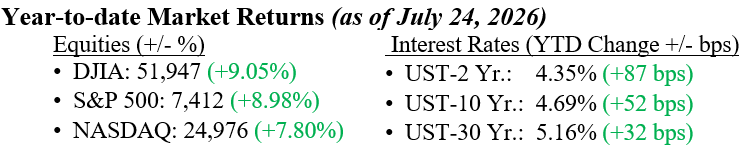
U.S. equities finished lower during the week ending July 24 as investors took a more cautious stance, with concerns around the payoff from heavy artificial intelligence (AI) investments and a sharp move higher in oil prices weighing on sentiment. The S&P 500, Nasdaq, and Dow all pulled back as investors assessed the outlook for corporate earnings and economic growth. Energy markets added to the uncertainty, with oil prices reaching six-week highs as Strait of Hormuz tanker traffic declined and renewed Houthi threats raised concerns across the Red Sea. Despite the market weakness, the economic backdrop remained healthy, with weekly initial jobless claims falling to their lowest level since 1969 and second-quarter earnings season continuing to come in stronger than expected, with roughly 88% of S&P 500 companies reporting results above estimates and blended earnings growth near 24.7%. The 10-year Treasury yield moved higher, ending the week at 4.69%, up 13 basis points from the prior week, as investors weighed rising inflation pressures driven by a resilient economy and higher energy prices. Markets are now focused on the Federal Reserve’s July 28-29 meeting for additional insight into the interest rate outlook. While near-term volatility may continue as investors digest geopolitical developments, policy changes, and shifting expectations around growth and inflation, we view the recent pullback as a normal market pause rather than a change in the broader outlook. We continue to believe that steady economic growth, strong corporate earnings, and America’s leadership in innovation provide a solid foundation for investors focused on their long-term financial goals.
U.S. & Global Economy
- While last week’s economic calendar was relatively light, the data that was released continued to highlight the underlying strength and resilience of the economy. The S&P Global Flash Composite PMI rose to an eight-month high of 53.6 in July, driven by stronger services activity that more than offset a modest slowdown in manufacturing. The labor market also remained firm, with weekly initial jobless claims falling to 187,000, the lowest level since 1969, while new home sales showed only modest improvement and remained pressured by affordability challenges. At the same time, businesses continued to see some inflationary pressure from higher input costs and supply chain disruptions tied to ongoing geopolitical issues. Consumer spending has remained a key area of strength, with many banks and credit card companies continuing to highlight a “resilient consumer” as spending trends remain healthy despite elevated prices and higher interest rates. Overall, the data continues to suggest that the economy is growing at a measured pace rather than weakening, supported by solid consumer activity, a healthy labor market, and continued business investment.
Policy and Politics
- The U.S.-Iran conflict remained the main headline last week, as continued military action and reports of possible renewed talks created uncertainty across energy markets. Oil prices jumped about 10% on the week, with Brent briefly topping $100 per barrel for the first time since May, as concerns over Red Sea disruptions and Strait of Hormuz supply flows added to market pressure before prices eased on Friday’s reports of potential diplomacy. Gas prices have also moved higher, now above $4 per gallon and up significantly since the conflict began. The Russia-Ukraine war added to global uncertainty as Ukraine continued expanding its long-range strikes deeper into Russian territory, targeting energy infrastructure and other strategic locations in an effort to pressure Moscow and disrupt supply chains. In response, Russia intensified its own missile and drone attacks, keeping concerns elevated around broader geopolitical risks and global commodity markets. Meanwhile, the Trump administration introduced a new round of tariffs covering roughly 60 trading partners, raising concerns about potential inflationary pressure from higher import costs. Overall, the combination of higher energy prices, geopolitical risks, and trade uncertainty has created new inflation concerns, though the underlying U.S. economy continues to show resilience.
For the week ahead, investors will be focused on the Federal Reserve’s upcoming policy meeting, with markets watching closely for any signals on the future path of interest rates. Beyond the Fed, the ongoing conflict with Iran and its impact on oil prices will remain a key focus, as energy markets continue to assess the potential inflationary effects of higher crude prices. Investors will also be navigating a busy earnings calendar, with results expected from several high-profile companies, including Visa, Microsoft, Meta, AstraZeneca, Apple, Amazon, and Mastercard. While markets may experience periods of volatility driven by earnings, Fed policy, and geopolitical developments, we continue to believe the broader investment environment remains supported by resilient economic fundamentals, strong corporate balance sheets, and continued innovation. We will continue monitoring incoming economic data, corporate results, and market developments for any signs of a shift in the current trajectory while remaining focused on long-term investment objectives.
Economic Numbers to Watch This Week
- U.S. Durable Goods Orders for June 2026, prior -4.5%
- U.S. Advance Economic Indicators Report for June 2026, prior -105.8B
- U.S. Conference Board Consumer Confidence for July 2026, prior 91.2
- U.S. Federal Open Market Committee Interest Rate Decision for July 2026, prior 3.8
- U.S. Advance (GDP) Estimate for Second Quarter 2026, prior 2.1%
- U.S. Initial Jobless Claims for Week Ended July 25, 2026, prior 187K
- U.S. Personal Income for June 2026, prior 0.7%
- U.S. Consumer Spending for June 2026, prior 0.7%
- U.S. PCE Price Index (Month-over-Month) for June 2026, prior 0.4%
- U.S. PCE Price Index (Year-over-Year) for June 2026, prior 4.1%
- U.S. Core PCE Price Index (Month-over-Month) for June 2026, prior 0.3%
- U.S. Core PCE Price Index (Year-over-Year) for June 2026, prior 3.4%
- U.S. Employment Cost Index for Second Quarter 2026, prior 0.9%
- U.S. University of Michigan Final Consumer Sentiment Survey for July 2026, prior 49.5
Please review Important Disclosure Information set forth in the last section of this web site.