
Last week, financial markets struck a balance between optimism and caution as investors sorted through mixed signals. U.S. stocks ended modestly higher, led by strength in technology and consumer discretionary names, while bond yields ticked up as inflation data suggested the Federal Reserve may not be in a hurry to cut rates. The Supreme Court also ruled that the Trump Administration cannot use the 1977 International Emergency Economic Powers Act (IEEPA) to impose tariffs, a decision that initially boosted markets by easing trade uncertainty. Still, that optimism was tempered by weaker-than-expected GDP data and a Personal Consumption Expenditures (PCE) report showing inflation remained higher than expected in December, complicating the broader outlook. Last week, the 10-year Treasury yield rose 3 basis points, closing at 4.08%.

U.S. & Global Economy
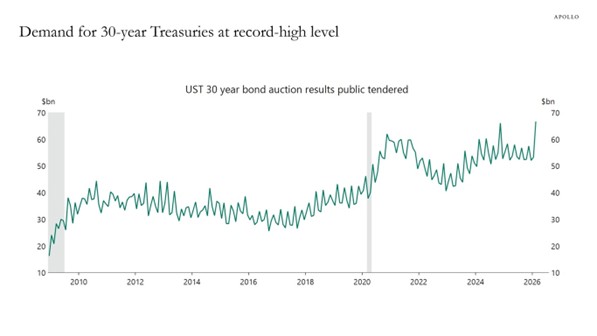
- See Chart 1 below from Apollo Global showing the latest 30‑year Treasury sale results. The results underscored a robust appetite for long‑dated U.S. debt, with public tenders reaching a record high. Indirect bidders, a common proxy for foreign demand, took 69.8% of the issue, versus a 64% historical average, while primary dealers received just 5.9% of the allocation. Taken together, the auction metrics point to persistently strong end‑investor demand for duration at the long end of the Treasury curve. This further illustrates the continued strength of U.S. Treasury bonds as the safety investment of choice for global markets, once again debunking the notion that the U.S. is losing its status as the most liquid and safest market.
- Economic reports last week offered a bit of everything for investors to digest. Regional manufacturing and housing data came in slightly better than expected, and jobless claims remained relatively steady, signaling continued labor market stability. The Fed’s January meeting minutes emphasized patience on rate cuts due to persistent inflation and solid growth. The biggest headline came on Friday, when Q4 GDP slowed sharply to 1.4%, well below expectations and down from Q3, largely due to reduced government spending (linked to the long federal shutdown) and a wider trade deficit. At the same time, headline and core PCE inflation both rose 0.4% in December, hotter than expected and keeping inflation concerns firmly in focus.
Policy and Politics
- Geopolitical tensions were back in focus last week, adding a fresh layer of uncertainty for markets. Oil prices climbed more than 3% after Ukraine-Russia peace talks fell apart, and Vice President Vance’s comments that Iran had ignored a key U.S. demand further raised the temperature. Reports also suggested the U.S. is prepared to strike Iran, if necessary, though President Trump has not made a final call. On the trade front, the Supreme Court ruled 6–3 in Learning Resources, Inc. v. Trump that the president cannot use the International Emergency Economic Powers Act (IEEPA) to impose sweeping tariffs, effectively wiping out billions in previously collected “Liberation Day” tariffs. President Trump quickly pushed back on the decision and announced plans to implement a new temporary 15% global tariff under Section 122 of the Trade Act of 1974, set to begin February 24 for an initial 150-day period.
This week, investors will have a few key economic data points to focus on, including consumer confidence, new home sales, and the final PPI inflation reading. Earnings from big names like NVIDIA, Home Depot, Lowes, and Salesforce will also draw attention, especially for signals on AI tech trends and consumer health. Geopolitical developments, particularly tensions involving Iran and Ukraine, along with oil prices, are likely to be closely watched for market-moving headlines. On top of that, President Trump’s State of the Union on Tuesday night (Feb. 24) could spark volatility if he signals changes on tariffs or corporate taxes, making it a week packed with both economic and political catalysts. As always, the team at Valley National Financial Advisors is here to help you navigate these developments and answer any questions you may have.
Economic Numbers to Watch This Week
- Factory Orders for December 2025, prior 2.7%
- Consumer Confidence for February 2026, prior 84.5
- Initial Jobless Claims for week ending February 21, 2026, prior 206,000
- Producer Price Index (PPI) for January 2026, prior 0.5%
- Core PPI for January 2026, prior 0.4%
- PPI Year-over-Year for January 2026, prior 3.0%
- Core PPI Year-over-Year for January 2026, prior 3.5%
- Construction Spending for November 2025, prior 0.5%
Please review Important Disclosure Information set forth in the last section of this web site.