
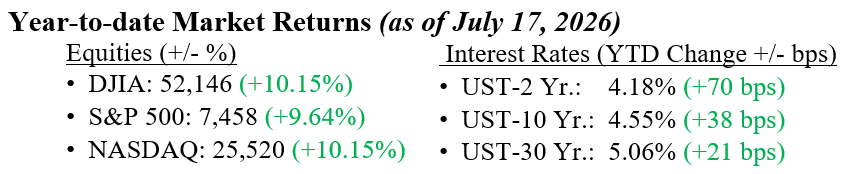
U.S. equities pulled back during the week ending July 17 as investors took profits in many of this year’s strongest AI and semiconductor stocks. The S&P 500 declined 1.6%, the Nasdaq fell 2.9%, and the Dow slipped 0.9%, marking a healthy pause following a strong first half of the year. Despite the weakness in technology, market fundamentals remained encouraging. Inflation data came in better than expected, reinforcing the view that price pressures continue to moderate, while the 10-year Treasury yield held relatively steady near 4.55%. Several of the nation’s largest banks also reported better-than-expected second-quarter earnings, highlighting the continued strength of consumer spending, credit quality, and overall economic activity. Investor attention is now shifting toward the broader second-quarter earnings season, when companies will need to demonstrate that significant investments in artificial intelligence are translating into stronger profits and productivity gains. Although geopolitical tensions in the Middle East resurfaced and contributed to higher oil prices, we view the recent market weakness as a normal consolidation rather than a change in the longer-term outlook. We continue to believe that resilient economic growth, moderating inflation, and America’s leadership in innovation provide a solid foundation for investors who stay focused on their long-term financial goals.
U.S. & Global Economy
- The U.S. economy continues to benefit from one of its greatest strengths—a resilient labor market. While hiring has moderated from the exceptionally strong pace of recent years, employment levels remain healthy, wage growth continues to support household incomes, and consumer spending has remained remarkably resilient. That is important because consumer spending accounts for approximately two-thirds of U.S. economic activity. At the same time, businesses continue to invest aggressively in artificial intelligence, automation, and other productivity-enhancing technologies. Rather than replacing workers on a broad scale, these investments are increasingly helping companies grow more efficiently while expanding their workforces. We believe the combination of a healthy labor market, strong consumer demand, rising productivity, and continued business investment provides a solid foundation for corporate earnings and long-term economic growth.
Policy and Politics
- Geopolitical developments remained a key focus for investors during the week as the conflict involving Iran escalated and commercial traffic through the Strait of Hormuz was temporarily disrupted, raising concerns about global energy supplies. Despite these developments, oil prices remain well below the highs reached earlier this year as increased production from other oil-producing nations and adjustments to global shipping and trade routes have helped offset some of the supply concerns. While geopolitical events can quickly influence short-term market sentiment and increase market volatility, history has consistently shown that well-diversified investors are generally rewarded for looking beyond the headlines. We continue to believe that resilient economic fundamentals, healthy corporate balance sheets, and the global economy’s ability to adapt to changing conditions provide a constructive backdrop for long-term investors. Regardless of sentiment, global policy and geopolitical events may influence market direction in the short run, but they have historically had little impact on long-term investment outcomes.
For the week ahead, the economic calendar is relatively light, with investors likely focusing more on oil prices and a busy slate of corporate earnings from Alphabet, Intel, Charles Schwab, Tesla, and Texas Instruments. As we progress through the second half of 2026, we continue to see an investment environment supported by resilient economic fundamentals, healthy corporate balance sheets, and America’s unmatched culture of innovation. While markets will undoubtedly experience periods of volatility driven by earnings reports, Federal Reserve policy, and geopolitical developments, those short-term events have done little to alter our long-term outlook. History consistently reminds us that successful investing is not about reacting to every headline but about remaining disciplined through changing market conditions. Our message has not changed: stay diversified, stay invested, ignore the day-to-day noise, and keep your focus on achieving your long-term financial goals. Investors who have followed that approach throughout 2026 have once again been rewarded. As always, please contact the team at Valley National Financial Advisors if you have any questions about the markets or your investment portfolio.
Economic Numbers to Watch This Week
- U.S. Leading Economic Indicators for June 2026, prior 0.1%
- U.S. Initial Jobless Claims for Week Ended July 18, 2026, prior 208K
- U.S. Kansas City Fed Manufacturing Survey for July 2026, prior 19
- U.S. S&P Global Flash Manufacturing PMI for July 2026, prior 55.7
- U.S. S&P Global Flash Services PMI for July 2026, prior 51.3
- U.S. New Home Sales for June 2026, prior 580K
Please review Important Disclosure Information set forth in the last section of this web site.