
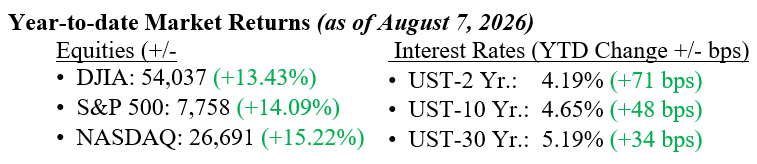
U.S. equities finished higher last week as another strong round of second-quarter earnings reinforced confidence in corporate America and the long-term AI investment story. The S&P 500, Nasdaq, and Dow all gained between 1% and 2%, recovering from the prior week’s modest pullback. While investors continue to evaluate whether significant artificial intelligence (AI) investments are translating into stronger revenue and earnings growth, overall corporate results have remained encouraging. Geopolitical sentiment also improved as optimism grew that Iran and Oman are moving closer to an agreement that could reopen the Strait of Hormuz, helping push oil prices lower and easing concerns about global energy supplies, although negotiations remain fluid. The week ended with a weaker-than-expected July jobs report, suggesting the labor market may finally be slowing after a prolonged period of strength. Despite ongoing geopolitical uncertainty, solid corporate earnings and a resilient U.S. economy continue to provide a constructive backdrop for long-term investors. Treasury bonds rallied as well last week, with the 10-year U.S. Treasury falling 6 basis points to close the week at 4.65%.
U.S. & Global Economy
- Despite ongoing headlines surrounding geopolitics, interest rates, and Washington, the underlying fundamentals of the U.S. economy remain constructive. The labor market remains a support for the economy, although job growth stalled in July. At 4.1%, the unemployment rate remains low, helping to support consumer spending and economic growth. Corporate America also remains in excellent shape, with second-quarter earnings once again exceeding expectations and S&P 500 companies delivering another quarter of double-digit earnings growth. The banking system is well-capitalized, credit conditions remain favorable, and banks are well-positioned to support continued lending to businesses and consumers. These three pillars, a strong consumer, growing corporate profits, and a healthy financial system, have helped drive double-digit returns for U.S. equities year to date and once again rewarded investors who have remained patient, diversified, and focused on their long-term investment plans.
Policy and Politics
- Geopolitical developments remained an important focus for global markets last week. Negotiations involving Iran, Oman, and other regional leaders continued over the future of the Strait of Hormuz, although meaningful differences remain before a final agreement can be reached. While diplomatic efforts have helped ease concerns over global energy supplies, sporadic attacks on commercial shipping and ongoing tensions in the Middle East remind investors that risks remain elevated. Elsewhere, the wars in Ukraine and Gaza continue with no clear resolution, while strategic competition between the U.S. and China over trade, technology, and national security continues to shape the global landscape. Despite these challenges, the global economy has remained remarkably resilient. Given all the geopolitical noise, financial markets continue to look beyond today’s headlines, pricing in eventual resolutions even though some conflicts—most notably Russia’s war in Ukraine—are unlikely to be settled anytime soon. As 2026 has demonstrated repeatedly, investors who have remained disciplined, diversified, and committed to their long-term investment plans have continued to be rewarded despite frequent geopolitical disruptions.
Looking ahead, investors will continue to focus on the key drivers that have fueled markets throughout 2026: corporate earnings, economic growth, and geopolitical developments. Although the second quarter earnings season is winding down, several notable companies will still report this week, including Cisco, Applied Materials, Cardinal Health, and Brinker International, providing additional insight into corporate profitability and the outlook for the second half of the year. Economic data will be closely watched for further signs that the labor market and consumer spending remain healthy, while inflation and interest rate expectations will continue to influence bond and equity markets. Overseas, investors will monitor negotiations surrounding the Strait of Hormuz, the ongoing wars in Ukraine and Gaza, and U.S.-China trade and security relations for any signs of progress or renewed tensions. While periods of volatility should be expected, we continue to believe the underlying fundamentals of the U.S. economy, a strong labor market, healthy consumers, growing corporate earnings, and a well-capitalized banking system, provide a constructive backdrop for long-term investors. As always, please contact your team at Valley National Financial Advisors for any questions.
Economic Numbers to Watch This Week
- U.S. NFIB Small Business Optimism Index for July 2026, prior 97.4
- U.S. Existing Home Sales for July 2026, prior 4.1Ma
- U.S. CPI for July 2026, prior -0.4%
- U.S. Core CPI (Month-over-Month) for July 2026, prior 0%
- U.S. CPI (Year-over-Year) for July 2026, prior 3.5%
- U.S. Core CPI (Year-over-Year) for July 2026, prior 2.6%
- U.S. Initial Jobless Claims for Week Ended August 8, 2026, prior 199K
- U.S. PPI for July 2026, prior -0.3%
- U.S. Ex-Food & Energy PPI (Month-over-Month) for July 2026, prior 0.2%
- U.S. Retail Sales for July 2026, prior 0.2%
- U.S. U. of Michigan Preliminary Consumer Survey for Aug 2026, prior 54.4
Please review Important Disclosure Information set forth in the last section of this web site.